
Soil health is the foundation of every productive farm and garden, yet it is often the last thing growers think about until plants struggle. Whether you cultivate a commercial field, tend a kitchen garden or grow ornamental plants in pots, the condition of the soil directly influences plant development — the nutrients roots can access, how long moisture lasts between watering, and whether the beneficial organisms that drive nutrient cycles thrive or not.
However, improving soil is not simply a matter of adding more fertiliser. Different soils have different requirements, and an organic soil amendment that works well in one situation may not address the needs of another. Some soils need better water retention in soil, others more organic matter, and others a combination of both.
Ecotrails Growme offers biochar, vermicompost, Biochar Green and fermented organic manure — all used in organic farming, each serving a different role. Understanding their characteristics helps farmers and gardeners make informed decisions based on actual soil conditions, crops and growing objectives.
Why Choosing the Right Soil Amendment Matters
Soil is a complex natural system. Its physical structure, nutrient content, moisture levels and biological activity all contribute to plant growth. Over time, intensive cultivation, erosion, excessive chemical inputs and the removal of crop residues can affect these characteristics — gradually reducing soil fertility and resilience.
A Ecotrails Growme Soil Solutions amendment addresses a specific limitation, but the first step is understanding what the soil actually needs:
- Sandy soil may benefit from improved organic matter and moisture retention.
- Heavy clay soil may require attention to drainage, aeration and structure.
- Nutrient-deficient soil may need an appropriate organic nutrient source.
- Degraded soil may benefit from a combination of amendments and improved cultivation practices.
- Container plants may require a balanced growing medium that supports both drainage and moisture availability.
Choosing products according to these requirements is more effective than applying the same input everywhere. The USDA’s Natural Resources Conservation Service describes soil health as the continued capacity of soil to function as a living ecosystem — and a thoughtful amendment choice protects that capacity. The FAO’s conservation agriculture guidelines reinforce the same point.
Why Soil Health Is Front-of-Mind for Rabi 2026-27
This is the right season to think carefully about soil inputs. India’s 2026 southwest monsoon ended at just 87% of its long-period average, the weakest since 2015. CropLife India issued a four-point advisory for Rabi 2026-27 specifically calling out uneven soil moisture as a factor that will influence crop establishment, pest pressure and the effectiveness of inputs across the season.
Soil rich in organic matter holds moisture more effectively and creates a more stable root environment — exactly what rabi crops like wheat, mustard and peas need during winter establishment. This makes building soil health now, before sowing, one of the highest-return decisions a farmer can make this season.
Organic inputs also align with India’s National Mission on Natural Farming and the PM-PRANAM scheme, both of which incentivise farmers to reduce chemical fertiliser use and build long-term soil health. The carbon sequestration in agriculture guide explains how these organic matter investments also contribute to India’s emerging carbon credit market.
Biochar: Supporting Long-Term Soil Conditioning
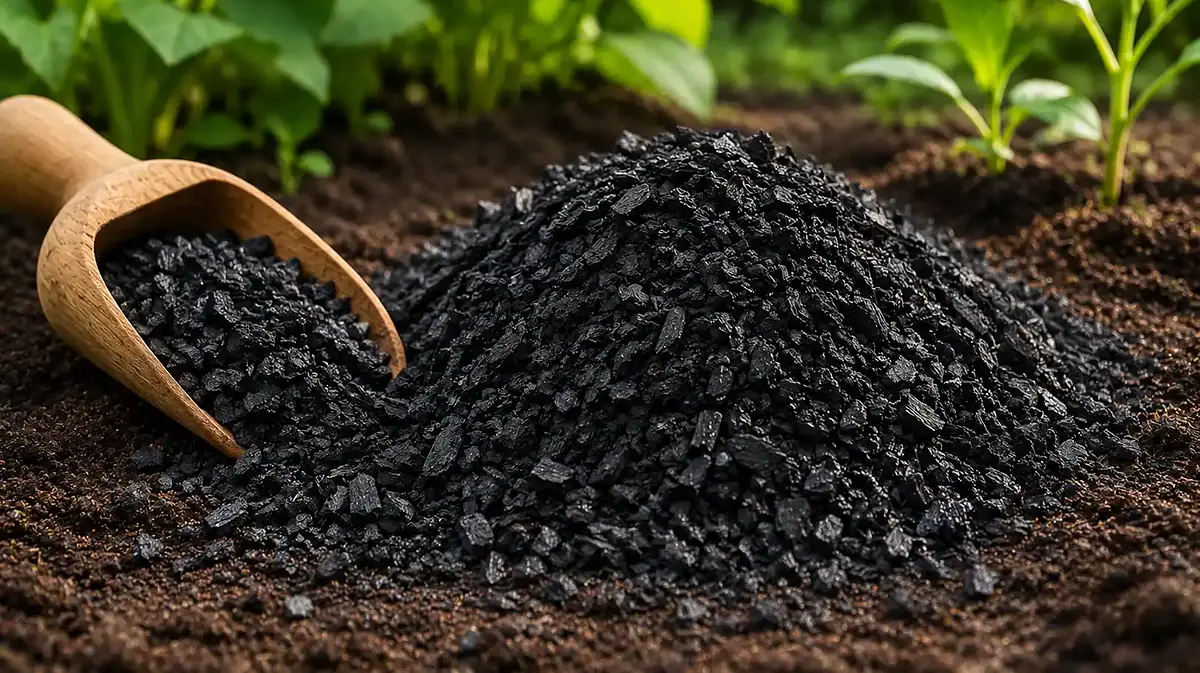
Biochar is a carbon-rich material produced by heating biomass under controlled conditions with limited oxygen. Its porous structure distinguishes it from conventional organic manures. Unlike nutrient-rich composts, biochar is primarily valued for its physical and carbon-related characteristics — it can help improve soil structure, support moisture retention and provide spaces for beneficial soil microorganisms.
Biochar for agriculture may be worth considering when:
- Soil has limited capacity to retain moisture.
- Long-term soil conditioning is a priority.
- The growing medium needs better physical structure.
- Growers want to incorporate a stable carbon-rich amendment.
- Gardeners are looking to improve potting soil characteristics.
Biochar should not automatically be treated as a complete fertiliser — it is best understood as a soil conditioner rather than a primary nutrient source. For growers seeking gradual improvements, it can be a useful component of a wider soil management plan. Our full guide on how biochar improves soil health covers the science in detail, and our water retention guide explains how it affects moisture management.
Ecotrails Growme’s Pure Biochar is produced specifically for farm and garden soil use.
Vermicompost: Adding Organic Matter and Nutrients
Vermicompost is produced when earthworms break down organic materials into a stable, nutrient-containing compost. It is widely used because it contributes organic matter and supports biological activity. The benefits of vermicompost for soil and plant growth are well documented — it can add organic matter, supply nutrients, support microbial activity, improve soil structure and help the soil retain moisture.
Ecotrails Growme’s vermicompost is intended for applications ranging from home gardens and pots to farms, lawns and horticultural settings. It is particularly relevant when the objective is to enrich soil and provide a source of organic nutrients. For a full breakdown of its advantages, read our guide on the benefits of vermicompost.
The appropriate quantity depends on the crop, soil condition and product specifications. Like any organic fertilizer, applying it responsibly matters as much as choosing the right type. More compost does not necessarily mean better results — applications should follow the manufacturer’s recommendations and the guidance in our organic soil amendments guide.
Biochar Green: Combined Soil Conditioning With Nutrient Support
Some growing conditions require more than one type of improvement. A farmer may want to address moisture retention while also supporting nutrient availability and microbial activity. Ecotrails Growme Biochar Green is a biochar-based soil amendment that combines the stable carbon structure of biochar with multiple nutrient sources. Its formulation is intended to support soil fertility, moisture retention and beneficial microbial activity.
The important distinction is that Biochar Green is more than biochar alone — it brings biochar together with multiple nutrient sources, making it a more complete combined input than either material on its own.
It may be relevant for farms seeking combined soil conditioning and nutrient support, home gardens with several soil requirements, and growing areas with limited moisture retention. Our biochar vs compost guide explains how to think about when a combined product makes sense.
Fermented Organic Manure: Supporting General Soil Fertility
Fermented organic manure is produced through the decomposition and fermentation of organic materials. Its role is different from a carbon-based amendment — organic manure contributes organic material and nutrients that support soil fertility and plant growth. It may be considered when cultivated soil needs additional organic inputs, or when farmers want to improve their nutrient management alongside crop rotation and cover crops.
The nutrient composition of fermented organic manure can vary, so checking the product label and technical information is important when planning applications for specific crops. India’s PM-PRANAM scheme provides a ₹1,500 per tonne subsidy to support FOM marketing, as we explain in our guide to FOM for sustainable farming.
Biochar, Vermicompost or Biochar Green: Which Product for Which Need?
These products are not interchangeable. Their main functions differ, and selecting the right one depends on the problem a grower is trying to address:
| Soil Requirement | Product | Main Purpose |
|---|---|---|
| Long-term carbon-rich soil conditioning | Biochar | Supports soil structure and moisture retention |
| Additional organic matter and nutrients | Vermicompost | Enriches soil and supports plant growth |
| Combined conditioning and nutrient support | Biochar Green | Brings stable carbon together with multiple nutrient sources |
| General organic nutrient enrichment | Fermented Organic Manure | Adds organic inputs and supports soil fertility |
In some situations, a combination of products may be appropriate. For example, biochar may be incorporated alongside vermicompost to address different soil requirements. However, combining amendments should be based on their composition and recommended application rates rather than an assumption that more products automatically produce better results. Soil testing is the most reliable starting point — use the government’s Soil Health Card scheme to understand pH, organic carbon and nutrient levels before selecting amendments.

Choosing Products for Farms and Home Gardens
For Agricultural Farms
Farmers generally need to consider soil conditions across a larger area alongside crop cycles, irrigation practices and nutrient requirements. A practical selection process starts with assessing soil texture, pH and organic matter, then identifying whether the main concern is moisture retention, nutrient availability or soil structure. Follow recommended application rates and monitor results over time.
For example, a field with low organic matter may benefit from an appropriate organic manure or vermicompost programme supported by natural farming principles, while a field where moisture retention and long-term conditioning are concerns may also benefit from biochar-based amendments. Our guide to improving soil fertility naturally walks through all the options.
For Home Gardens and Potted Plants
Gardeners often work with smaller quantities of soil, but the same principles apply. Containers have limited space, and their growing media can lose nutrients through repeated watering and plant growth. Earthworm compost enriches garden soil, while biochar-based products help improve the characteristics of suitable growing media. Before adding any amendment, consider drainage, whether the existing soil is compacted, what the plant requires, and how frequently it is watered. Our guide to biochar for home gardening covers pot and terrace garden applications in detail.
How to Use Soil Products Responsibly
Even suitable organic solutions need to be applied correctly. Product quality, dosage, soil conditions and timing can all influence the outcome. A few practical guidelines:
- Read the product instructions before application.
- Test the soil when managing larger agricultural areas.
- Avoid excessive application, particularly when nutrient levels are already adequate.
- Mix amendments evenly where the product instructions recommend incorporation.
- Maintain suitable irrigation and drainage — mulching after application slows moisture loss.
- Observe plant response and soil condition across successive seasons.
- Store products according to the manufacturer’s guidance.
Soil improvement takes time. Biochar may remain in soil for an extended period, while organic manures and vermicompost undergo biological decomposition — their effects and application frequency are therefore different. No amendment can compensate for every underlying problem; poor drainage, unsuitable pH, plant disease and irrigation mistakes may require separate corrective measures. Our guide to soil microorganisms explains why feeding the biological community matters as much as adding physical amendments.

Conclusion
Choosing the right organic soil amendment begins with understanding what the soil actually needs. Biochar, vermicompost, Biochar Green and fermented organic manure each contribute differently to soil health and plant growth, and knowing these differences makes it easier to select an appropriate solution for a farm, garden or growing space.
With India’s rabi sowing season underway against the backdrop of the weakest monsoon in a decade, building soil organic matter and improving moisture retention are among the most practical steps a grower can take right now. Ecotrails Growme’s range gives you targeted options rather than one-size-fits-all inputs.
Successful results depend on responsible application, suitable growing practices and an understanding of the soil’s existing condition. Healthy soil is built through consistent care rather than a single application. For more practical guides, explore our Resources & Knowledge Centre, or review how other growers have used these inputs in our farmer testimonials.
Frequently Asked Questions (FAQs)
What are organic soil solutions?
Organic soil solutions are naturally derived materials used to improve soil properties and support plant growth. They may contribute organic matter, nutrients, moisture retention or better soil structure, depending on their composition.
What is the difference between biochar and vermicompost?
Biochar is a stable, carbon-rich soil conditioner valued mainly for its porous structure and potential to support moisture retention. Vermicompost is produced through earthworm decomposition and contributes organic matter and nutrients.
What is Biochar Green used for?
Ecotrails Growme Biochar Green is a combined biochar-based soil amendment that brings together biochar’s stable carbon structure with multiple nutrient sources. Its suitability depends on the crop, soil condition and recommended application rate.
Is vermicompost suitable for home gardens?
Yes. Vermicompost can be used in garden beds, pots and suitable growing media. It contributes organic matter and nutrients, but the quantity should be adjusted according to plant requirements and product instructions.
Can biochar and earthworm compost be used together?
Yes. They may be used together when their different functions address the needs of the soil. Biochar contributes a stable carbon-rich structure, while earthworm compost supplies organic matter and nutrients. Follow product guidance to determine suitable proportions.
Ready to Build Healthier Soil?
Ecotrails Growme offers Pure Biochar, vermicompost, Biochar Green and fermented organic manure for farms and gardens of every size. Start with a soil test, pick the right product, and track the difference across seasons.
Buy Retail or Wholesale Talk to Us